AI Contract Review: How AI Agents Speed Up Legal Review from Weeks to Minutes
The legal field has always relied on careful reading, thorough analysis, and extensive review processes. Drafting contracts, reviewing them, and comparing clauses can take hours or even weeks especially during mergers, acquisitions, or significant vendor assessments. But now, AI is transforming this entire process, making legal reviews faster, more accurate, and much more efficient.
With AI-driven systems, we can now analyze complex documents, grasp legal jargon , and pinpoint risks in an instant. Legal teams can utilize automated tools that interpret contracts, highlight unusual terms, and ensure compliance in just minutes. This transformation enables lawyers to concentrate on strategy, negotiation, and decision-making.

The legal field has always relied on careful reading, thorough analysis, and extensive review processes. Drafting contracts, reviewing them, and comparing clauses can take hours or even weeks especially during mergers, acquisitions, or significant vendor assessments. But now, AI is transforming this entire process, making legal reviews faster, more accurate, and much more efficient.
With AI-driven systems, we can now analyze complex documents, grasp legal jargon , and pinpoint risks in an instant. Legal teams can utilize automated tools that interpret contracts, highlight unusual terms, and ensure compliance in just minutes. This transformation enables lawyers to concentrate on strategy, negotiation, and decision-making.
AI for faster, smarter contract review
Traditional contract reviews can really bog down legal teams since every single line needs a thorough check for accuracy, obligations, renewal terms, and potential risks. But with AI tools powered by Natural Language Processing (NLP), it is possible to examine through thousands of documents simultaneously, pulling out essential details, spotting risky clauses, and matching text against approved templates. This not only cuts down on human errors but also keeps contracts consistent.
Can AI really understand complex legal language without missing context?

Absolutely! Today's advanced AI tools, which are trained on extensive legal datasets, can effectively interpret definitions, obligations, renewal terms, and even those risk-heavy clause while maintaining the context. They are great at spotting irregularities, comparing against known templates, and flagging any clauses that deviate from the approved standards.
Take, for instance, an M&A review where numerous supplier agreements had to be examined. Instead of dragging on for weeks, AI summarizes all the key points in just a few hours, allowing lawyers to focus on what's required. The outcome? Quicker review cycles and a boost in confidence regarding the findings.
Traditional contract reviews can really bog down legal teams since every single line needs a thorough check for accuracy, obligations, renewal terms, and potential risks. But with AI tools powered by Natural Language Processing (NLP), it is possible to examine through thousands of documents simultaneously, pulling out essential details, spotting risky clauses, and matching text against approved templates. This not only cuts down on human errors but also keeps contracts consistent.
Can AI really understand complex legal language without missing context?
Absolutely! Today's advanced AI tools, which are trained on extensive legal datasets, can effectively interpret definitions, obligations, renewal terms, and even those risk-heavy clause while maintaining the context. They are great at spotting irregularities, comparing against known templates, and flagging any clauses that deviate from the approved standards.
Take, for instance, an M&A review where numerous supplier agreements had to be examined. Instead of dragging on for weeks, AI summarizes all the key points in just a few hours, allowing lawyers to focus on what's required. The outcome? Quicker review cycles and a boost in confidence regarding the findings.
AI for clause analysis at scale
Clause analysis can get tricky, especially when dealing with hundreds of documents that each have their own slightly different takes from confidentiality clauses, to payment conditions. AI helps sorting through these clauses, rates their similarities, spots any deviations from the established policy, and keeps track of all changes. This allows to create dynamic clause libraries that store all changes and every contract analysed.
How does AI handle clauses that use different wording but mean the same thing?
AI groups similar clauses by using semantic matching. Even when the words are different, AI can still grasp the intent and meaning, which helps legal teams quickly spot patterns, inconsistencies, and risks across hundreds of documents.
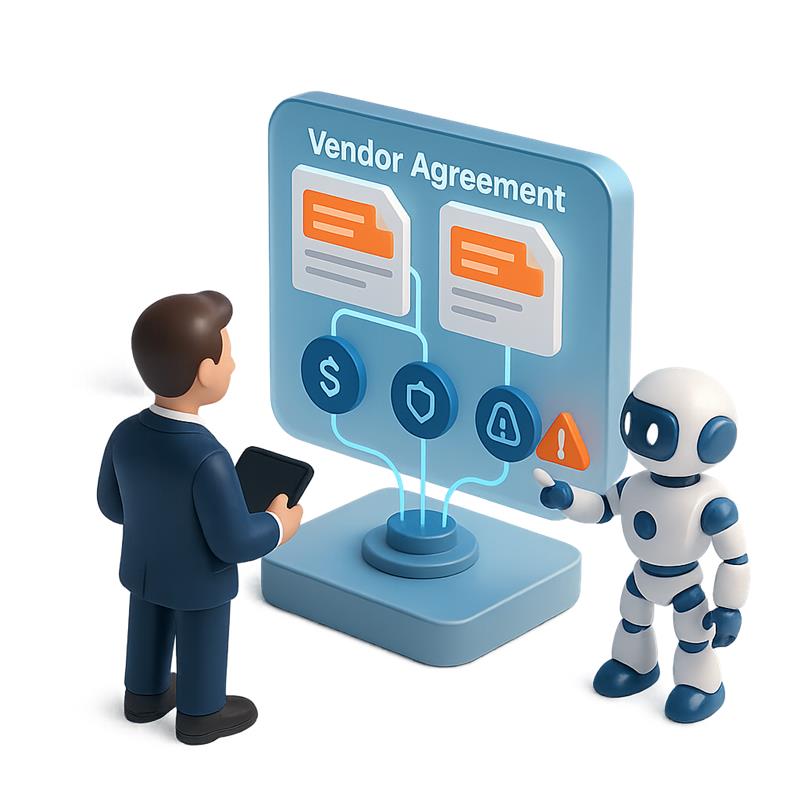
For instance, in larger organizations using AI, vendor agreements can be quickly scanned to pinpoint clauses that might put the company at financial or legal risk.
This proactive approach helps teams fix inconsistencies before they raise disputes.
How does AI handle clauses that use different wording but mean the same thing?
AI groups similar clauses by using semantic matching. Even when the words are different, AI can still grasp the intent and meaning, which helps legal teams quickly spot patterns, inconsistencies, and risks across hundreds of documents.
For instance, in larger organizations using AI, vendor agreements can be quickly scanned to pinpoint clauses that might put the company at financial or legal risk. This proactive approach helps teams fix inconsistencies before they raise disputes.
A shift towards intelligent legal workflows

AI isn't here to take over the role of lawyers; instead, it's all about boosting their skills. With automated reviews and quick insights, legal teams can speed up their processes, cut down on costs, and dedicate more time to the important stuff.
The future of legal operations is all about AI-powered workflows that blend speed, precision, and smart predictions.
With evolving technologies, legal teams will have access to even more robust tools for making informed decisions and ensuring better compliance.
A shift towards intelligent legal workflows
AI isn't here to take over the role of lawyers; instead, it's all about boosting their skills. With automated reviews and quick insights, legal teams can speed up their processes, cut down on costs, and dedicate more time to the important stuff.
The future of legal operations is all about AI-powered workflows that blend speed, precision, and smart predictions. With evolving technologies, legal teams will have access to even more robust tools for making informed decisions and ensuring better compliance.
Frequently Asked Questions

About the Author
Navith
Media Intelligence & Vision Analytics
Driving customer growth through intelligent, data-driven CRM automation.